
How to Search the Faribault County Court Docket
Start with Minnesota Court Records Online, or MCRO. It is the main remote route into Faribault County court records. It reaches publicly accessible Minnesota District Court cases, Faribault County among them. Pick the tab that fits what you have: a name, a full case number, a citation number, or an attorney. A full case number works best. Name searches go smoother when you choose person or business first. Then narrow by the Faribault County location and case category.
Treat MCRO as an access copy rather than the official record. Privacy rules, older documents, and your choice of search method can all limit what appears. Court Administration in Blue Earth can answer case-specific questions. It can also run a fuller search on a public terminal, or issue a formal copy. Jot down the case number, category, and filing date from any result. Those details sharpen a later docket lookup or records request.
- Open MCRO Case Search and choose the name, case-number, citation-number, or attorney route that matches the information available.
- For a name search, add Faribault County and a case category before relying on a broad list of matches.
- Open Case Details to read the Register of Actions, case status, hearings, events, and public document-index fields.
- Use Hearing Search or the local calendar when the immediate question is a court date rather than the whole case history.
- Ask Faribault County Court Administration for a certified, exemplified, older, or unavailable record.
Faribault County Court Docket Access
Two systems carry the Faribault County court docket path. MCRO is the remote, statewide interface. MPA Courthouse is the terminal inside district courthouses. It can show more complete public electronic information than the remote product. Neither one certifies the underlying record. When a remote result comes up empty, the local counter can say which channel fits.
The official MCRO overview lays out the remote product and its limits. Case Search finds a case. Document Search pulls available filings by full case number. Hearing Search lists scheduled settings. Judgment Search adds a supplementary judgment lookup. A document search will not substitute for a name-based case search. A judgment result never amounts to a full civil case history.
The Judicial Branch MCRO overview presents the public access system. It stands behind Faribault County court docket searches.
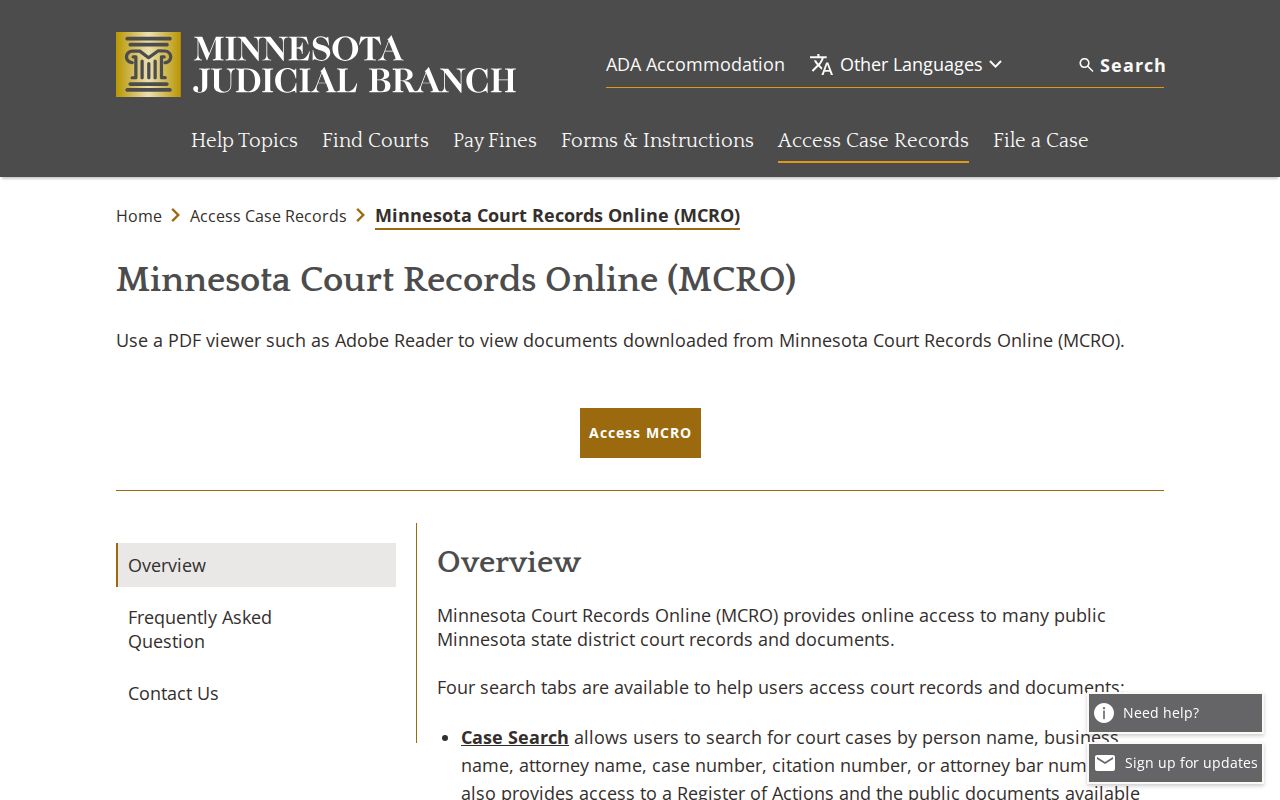
Start with the state system. That way a remote search, a hearing query, and a copy request stay clearly separate.
What a Court Docket Shows
A Faribault County court docket is the public-facing sequence of activity in one case. MCRO shows that sequence through Case Details and Case Events. Both sit in the Register of Actions. An entry tells you a filing, hearing, order, disposition, or document index exists. Often the wording is brief. When a linked document is public, read it there. It shows the actual filing or order.
A calendar works differently. It shows a hearing is scheduled, plus the details that identify it. A setting marked plea, sentencing, motion hearing, or trial says nothing about the result. Check the later event or an authorized document. Do that before concluding what happened in a Faribault County court case.
| Case number | The complete court identifier used for the most precise MCRO search. |
|---|---|
| Case title and category | Public case label and broad type, such as civil, criminal, family, or probate or mental health. |
| Case events | Chronological Register of Actions entries such as filing, hearing, motion, order, or disposition. |
| Hearing details | Scheduled date, time, location, judicial officer, hearing type, and connection type where public. |
| Document index | A reference to a filing or order that may be available through Document Search or the court office. |
| Access indicators | Restrictions can affect which case details and documents appear remotely. |
Faribault County District Court is the local trial-court destination behind those records.
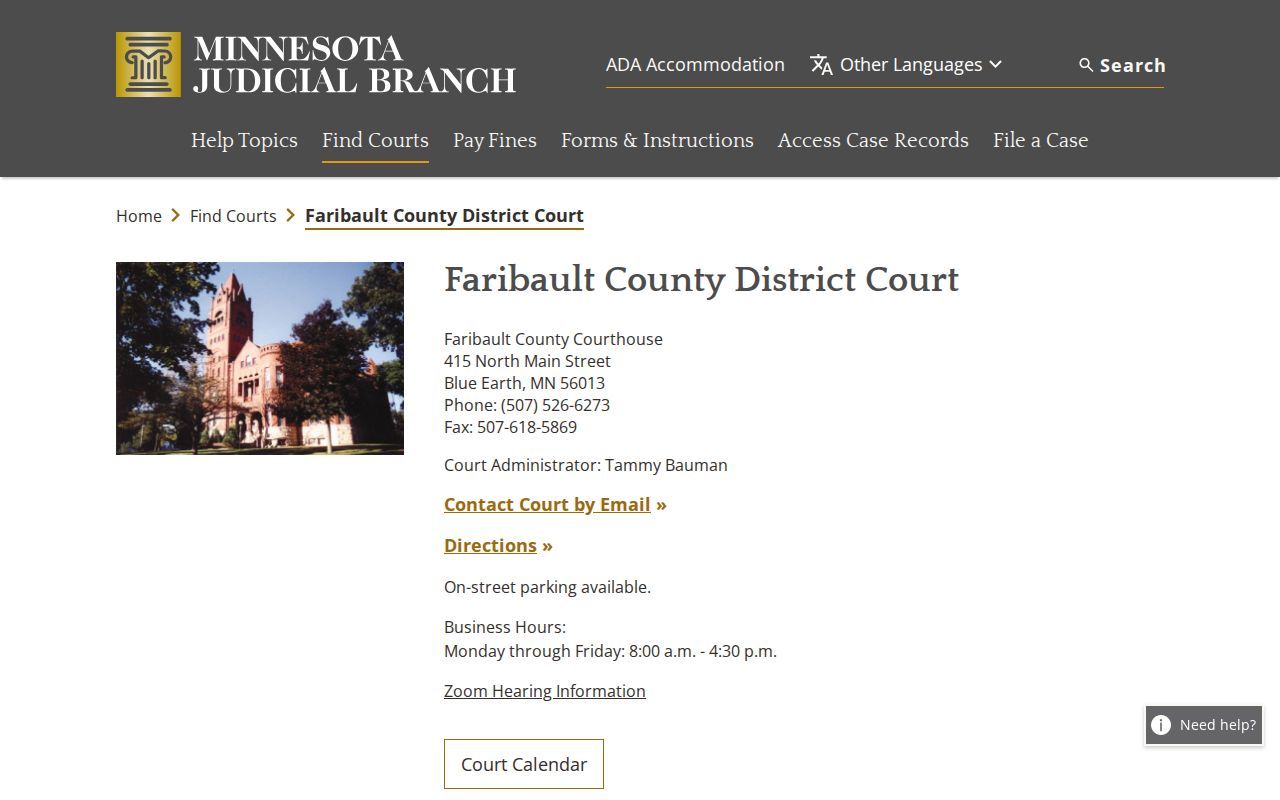
The local court page bridges two things. It links the online Register of Actions to the clerk's office that answers calendar and record-copy questions.
Faribault County Court Docket Numbers
Faribault County calendar examples follow a pattern like 22-CR-26-625, 22-VB-26-520, and 22-CV-26-503. The letters are handy search clues. CR showed up on a criminal case. VB marked a violation-style traffic matter. CV marked a civil one. No complete local code dictionary exists here. Weigh the letters against the case category and the Register of Actions rather than reading them as a legal answer.
Type a complete MCRO case number without spaces. The remote Case Number search accepts dashes and leading zeroes. If you know only part of a number, try a name or citation search carefully. Then verify the match with the filing date, court location, and case type. An incomplete number tends to return an error, not a helpful partial match.
- Register of Actions
- The chronological case activity view reached through MCRO Case Details.
- Case event
- An entry showing a step in the case, not necessarily the full text of its document.
- Citation number
- The identifier on a traffic or petty-offense citation, searchable on MCRO’s dedicated tab.
- Disposition
- The recorded resolution or procedural outcome, which must be read in context.
Which Courts Keep Dockets
Faribault County runs on a unified Minnesota District Court path. Faribault County District Court holds original jurisdiction. It covers the county's civil, criminal, traffic, family, probate, juvenile, and conciliation cases. The Fifth Judicial District is administrative, spanning 15 southwest Minnesota counties. It runs no second local trial docket. An appeal or a federal matter belongs to a different court system entirely. It will not sit in the Faribault County Register of Actions.
| Court or system | Faribault County role | Where to start |
|---|---|---|
| Faribault County District Court | Local trial cases, including criminal, civil, traffic, family, probate, juvenile, and conciliation matters. | MCRO or Faribault County Court Administration. |
| Fifth Judicial District | Administrative structure and district policy, not a separate county case docket. | District resources and the county court that filed the case. |
| Minnesota Court of Appeals | Appeals from District Court under appellate procedures. | Appellate resources, not the Faribault MCRO case route. |
| Federal District of Minnesota | Separate federal actions connected to the area. | Federal PACER, not Minnesota MCRO. |
The Fifth Judicial District overview explains the district’s administrative role.
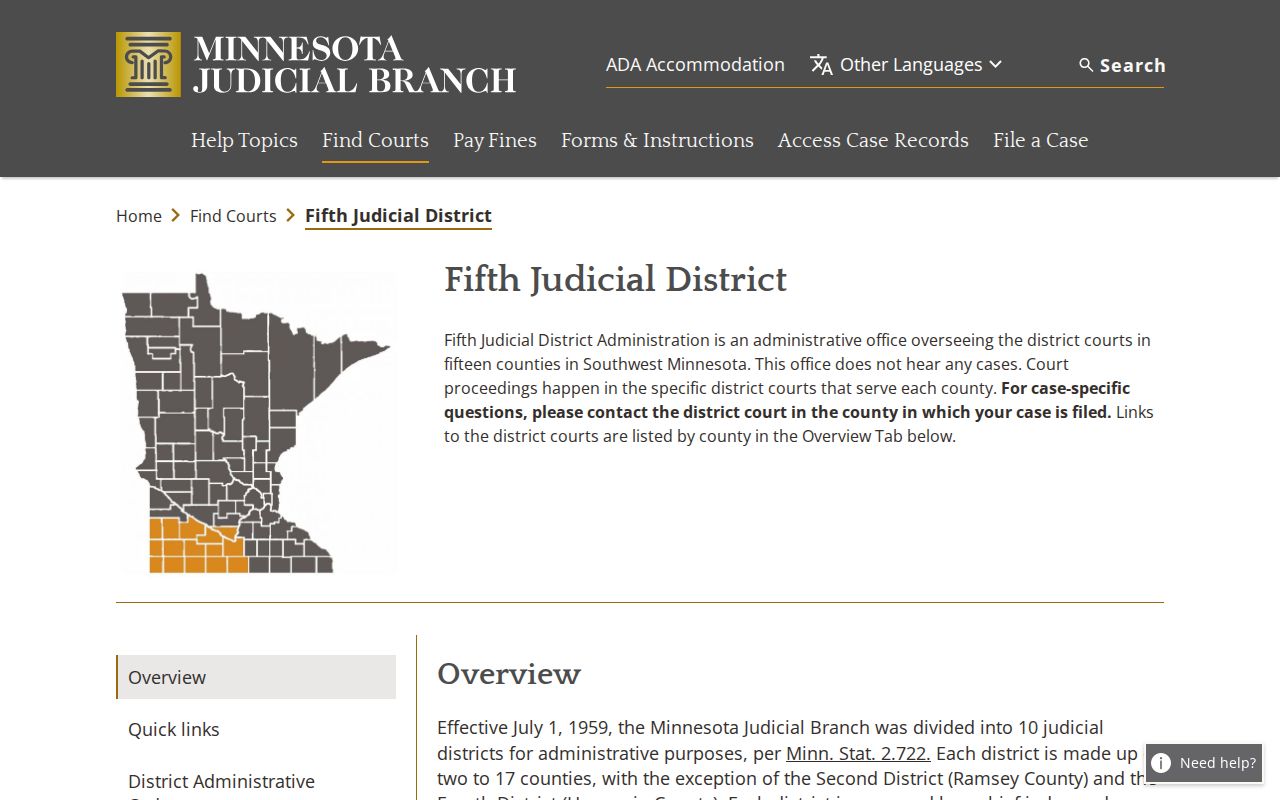
That distinction keeps a Faribault County docket search pointed at the court that actually holds the case file.
Faribault County Treatment Court Records
Some Faribault County District Court cases run through the Southern Prairie Treatment Court. That program includes the Faribault-Martin-Jackson Adult Drug Court and Family Dependency Treatment Court. It is a multi-county Fifth District program, not a separate public courthouse docket. When the underlying case is public, its hearings, orders, conditions, and disposition entries surface in the District Court Register of Actions. Joining the program does not open treatment, probation, assessment, medical, or social-service records to the public. A public case status does not guarantee that every related document is viewable online. The official county-specific treatment-court information covers program context. Court Administration handles record-access questions.
Minnesota's court finder holds the statewide map placing Faribault trial work in District Court.
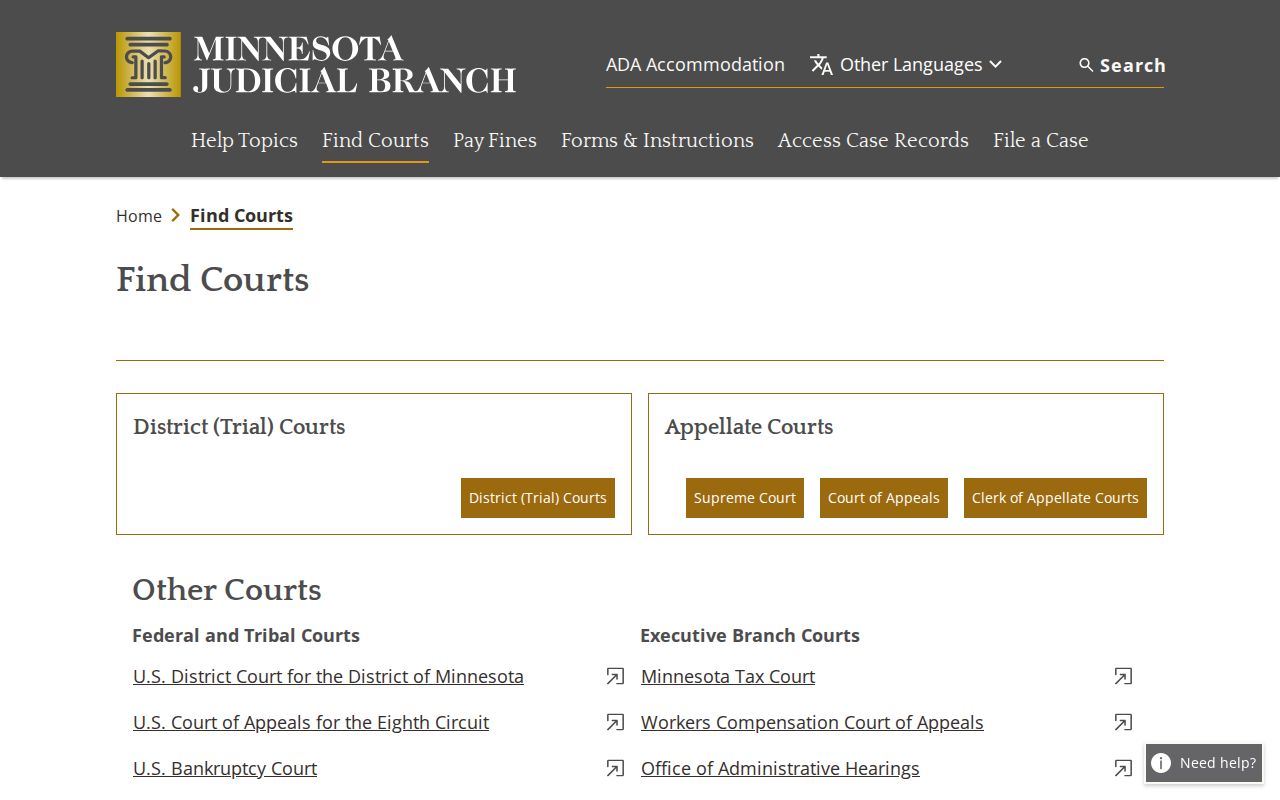
The statewide map helps here. It keeps a city or program name from being mistaken for its own case-search system.
Finding Court Dates and Settings
Two tools cover a Faribault County court date. Use MCRO Hearing Search. Or pull the local calendar PDF, which posts at 7:00 a.m. each business day and updates hourly. Searching by case number gives the cleanest result. A public row may show the party role, hearing location, date, time, judicial officer, hearing type, connection type, and case number. The Faribault public court calendar is the official local schedule.
Read across the whole row before drawing conclusions. A label like arraignment, pre-trial, motion hearing, plea hearing, sentencing, or jury trial names the kind of setting only. It says nothing about the outcome. Courtroom and judicial-officer assignments shift. So the court treats printed calendars outside courtrooms and in public lobbies as the most current daily information.
Faribault County Court Docket Calendar Limits
A missing Faribault County calendar entry does not cancel a hearing. The PDF leaves out confidential cases. It also omits matters that Minnesota public-access rules bar from remote view. A case may also be newly changed, filed under a different searchable field, or simply outside the public calendar's daily scope. Compare the case number and your notice first. Then check the PDF update time. Run MCRO Hearing Search if a setting should be searchable.
Still uncertain? Call Faribault County Court Administration at (507) 526-6273. An unlisted or stale online row never excuses an appearance. Under Fifth District practice, a continuance takes a request or motion and good cause. Until the court confirms a change, the existing notice controls.
Calendar caution: A hearing label is a schedule entry, not a ruling, and an absent public-calendar row is not proof that a setting was canceled.
Public Access to Dockets
The Minnesota Rules of Public Access to Records of the Judicial Branch govern access at Faribault County District Court. Rule 2 presumes court and administrative records are open during regular hours. Listed exceptions apply. Rule 8 handles inspection, copying, bulk access, and remote access. Rule 9 adds a written appeal to the State Court Administrator when access is denied or limited.
Public access still is not unlimited remote access. Sealed files, restricted identifiers, juvenile and protected matters, court-services data, and category-specific rules can all limit a result or document. MCRO has its own remote-document coverage limits too. When it matters, verify with the record custodian. Do this especially for a certified copy, an appeal, or a case that looks incomplete.
Key Rules:
Minnesota Rules of Public Access establish the open-record presumption and exceptions for judicial records.
Rule 8 addresses remote and copying access, while Rule 9 supplies a written route for an access appeal.
General Rules of Practice Rule 11 restricts identifiers such as account numbers and other protected filing information.
Faribault County Court Record Channels
Faribault County offers more than one route when MCRO is not enough. Start from home with Case Search, Document Search, Hearing Search, or Judgment Search. Inside a district courthouse, an MPA Courthouse terminal gives a fuller public electronic view. At the Blue Earth counter, Court Administration can walk through a calendar, locate an eligible file, and process public or certified copies. You can also send a written request. Use the statewide form. Or send a letter carrying the same locating details.
A copy request should include the county, court file number if known, case category, party roles or other locating details. It should also cover the document description, date or index number, copy type, delivery preference, and payment information. Mail, pickup, fax, email, and prepaid carrier delivery are all allowed. Fax and email cover plain, non-confidential copies only. The form sets no universal turnaround time, identification rule, or counter cutoff. Confirm those details with the court. The statewide copy-request form lists exactly what helps Court Administration find the right document.
The Clerk and Docket Records
Faribault County Court Administration is the practical recordkeeper. It is the first contact for District Court calendars, copies, filed papers, and public-terminal questions. Minnesota runs a unified court system. So there is no parallel district-clerk, county-clerk, traffic-clerk, or municipal-court counter for the same case. Know the case category and full number when you can, then ask which access route fits.
Plain viewing or an uncertified print may be free under the court's fee schedule. Certification changes the math. The Faribault fee page lists $14 for a certified civil or criminal instrument. It lists $28 for certified plus exemplified, and separate charges for scanning, faxing, and certain reports. Confirm the current item and total before ordering. A downloaded MCRO document or payment receipt is not automatically a certified record.
Faribault County Court Administration
415 North Main Street, P.O. Box 130
Blue Earth, MN 56013-0130
(507) 526-6273
Faribault County Court Docket Technology
Faribault County’s court records now sit on the state’s newer tools rather than only behind a clerk’s counter. Minnesota’s own materials date the pieces. Document Search arrived in March 2021, and Case Search in December 2021. Hearing and Judgment Search followed in August 2022. In April 2023, MCRO replaced MPA Remote as the public search platform. MNCIS still serves as the case-management system. That is where the official record lives. Think of MCRO as the remote window into it. MPA Courthouse, meanwhile, stays in place as the terminal you use in person.
The Blue Earth courthouse gives that system a physical home with deep roots. Completed in December 1892, the building gained a west wing in 1974. It joined the National Register in 1977. Court business ran even earlier. It operated out of a private residence before construction began. Remote tools ease the first docket search. Formal verification still belongs to the court that holds the record.
The courthouse history carries that story from the earliest sessions to the present building.
Faribault County government rounds out the picture with county-level details on the courthouse location.
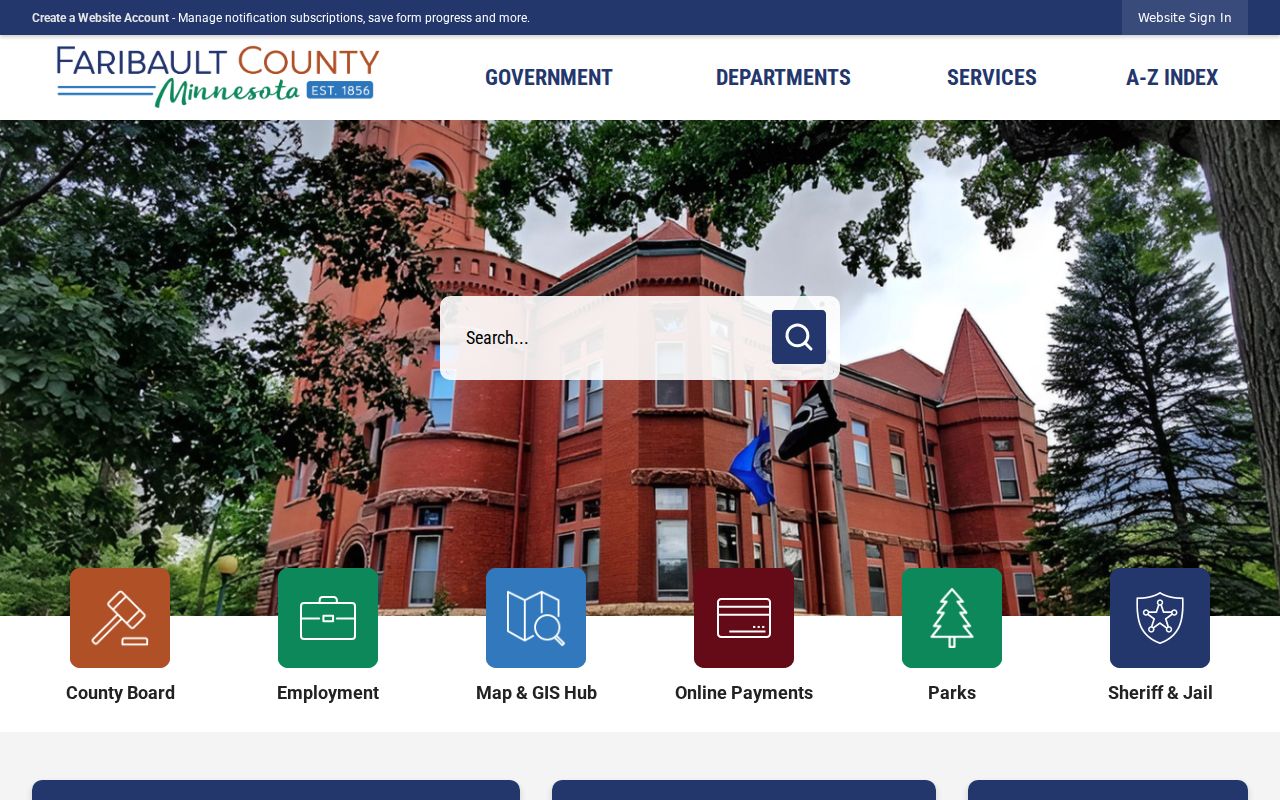
County government materials point back to Court Administration as the place to request official court-file access in Faribault County.
Court Dockets by City in Faribault County
Blue Earth, Wells, Winnebago, Minnesota Lake, and Kiester are the five largest incorporated cities in Faribault County. That ranking comes from the 2020 Census table. Each runs its own government and ordinances. None of them operates a separate municipal trial-court docket. A city-related case is filed with the Faribault County District Court. It then shows up through MCRO. The city page helps you tell the city-government contact apart from the county court-record path. That way a court records request goes to the right office.
Blue Earth Court Docket
2020 Census population 3,174. The county-seat courthouse and Court Administration are located in Blue Earth.
Wells Court Docket
2020 Census population 2,410. City-government information and District Court records use separate channels.
Winnebago Court Docket
2020 Census population 1,391. City public-safety context does not replace the District Court Register of Actions.
Minnesota Lake Court Docket
2020 Census population 661. Remote MCRO access can be useful before a trip to the county seat.
Kiester Court Docket
2020 Census population 488. City Hall and Court Administration answer different record questions.
Minnesota appellate resources explain why an appeal must be searched separately from a local trial-court docket.
City location, trial-court case, and appeal are distinct parts of the Minnesota court structure.
Faribault County Court Docket Essentials
Begin any Faribault County court docket search with the strongest identifier you have. That means a complete case number, a citation number, or a carefully narrowed name search. Use a calendar for scheduling questions. Use a Register of Actions for case activity. When the remote record falls short, try the MPA Courthouse terminal, the Court Administration counter, or a written copy request. A result that affects an appearance, filing, or formal record need should be verified with the originating court. This chain keeps Faribault County court docket work tied to the public court systems that hold the case record. It also keeps a city-government inquiry, a trial-court case, and an appellate matter in their own lanes. No single database treats every public record alike. The Minnesota Court of Appeals overview explains the separate state appellate record path.
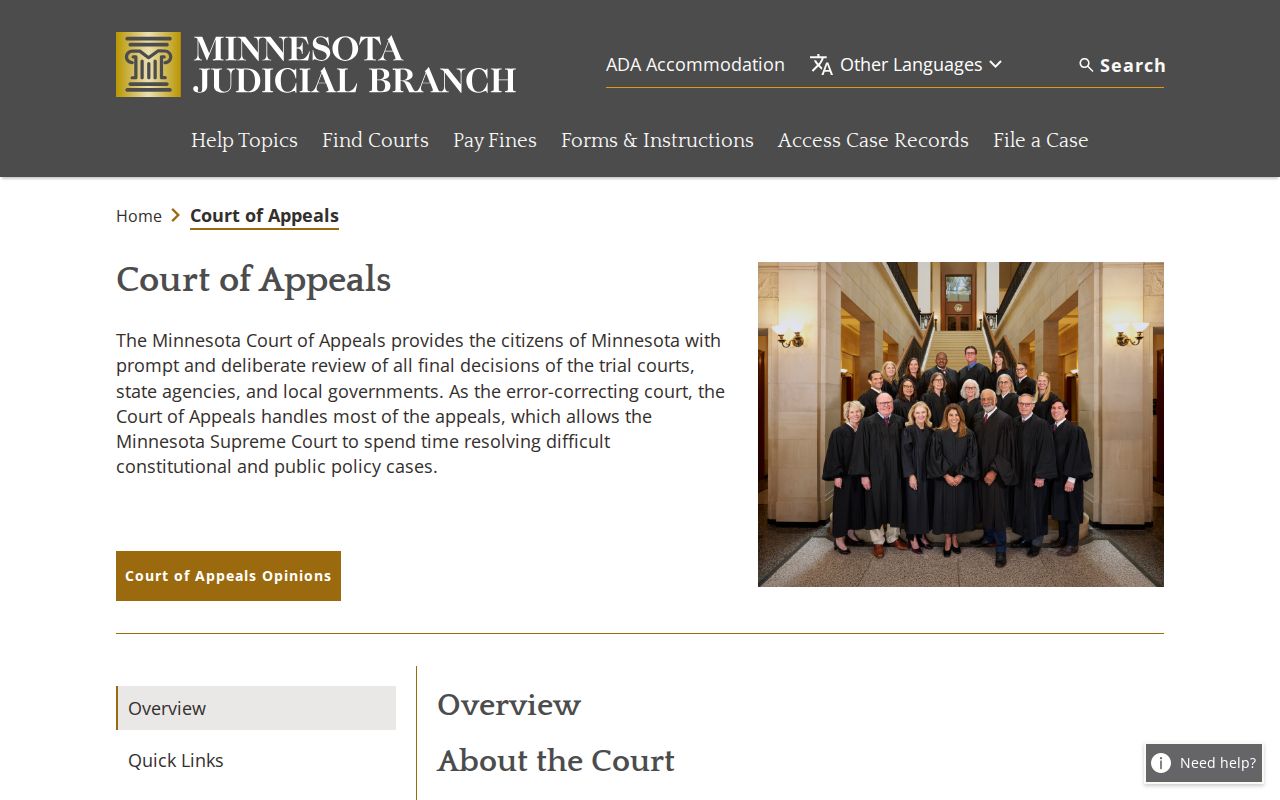
The state judiciary keeps appellate information on its own separate pages. That separation is worth remembering, since each court level maintains its own record path for a Faribault County case lookup.
Map and Directions to the Faribault County Courthouse
Faribault County District Court files are kept at Court Administration inside the Faribault County Courthouse, 415 North Main Street, in Blue Earth. The present building dates to 1892, built of Kasota stone with a rusticated limestone basement, and has been listed on the National Register of Historic Places since 1977. Ask for Court Administration and give the case category or complete case number rather than looking for a separate county- or district-clerk counter.
Faribault County Court Administration
415 North Main Street, P.O. Box 130
Blue Earth, MN 56013-0130
(507) 526-6273
Monday-Friday, 8:00 a.m.-4:30 p.m.
The official court page lists on-street parking at the courthouse but does not detail security screening or a public-terminal room location, so a first-time visitor should call ahead. Payments are not accepted at the service counter after 2:30 p.m. on the last working day of the month.